
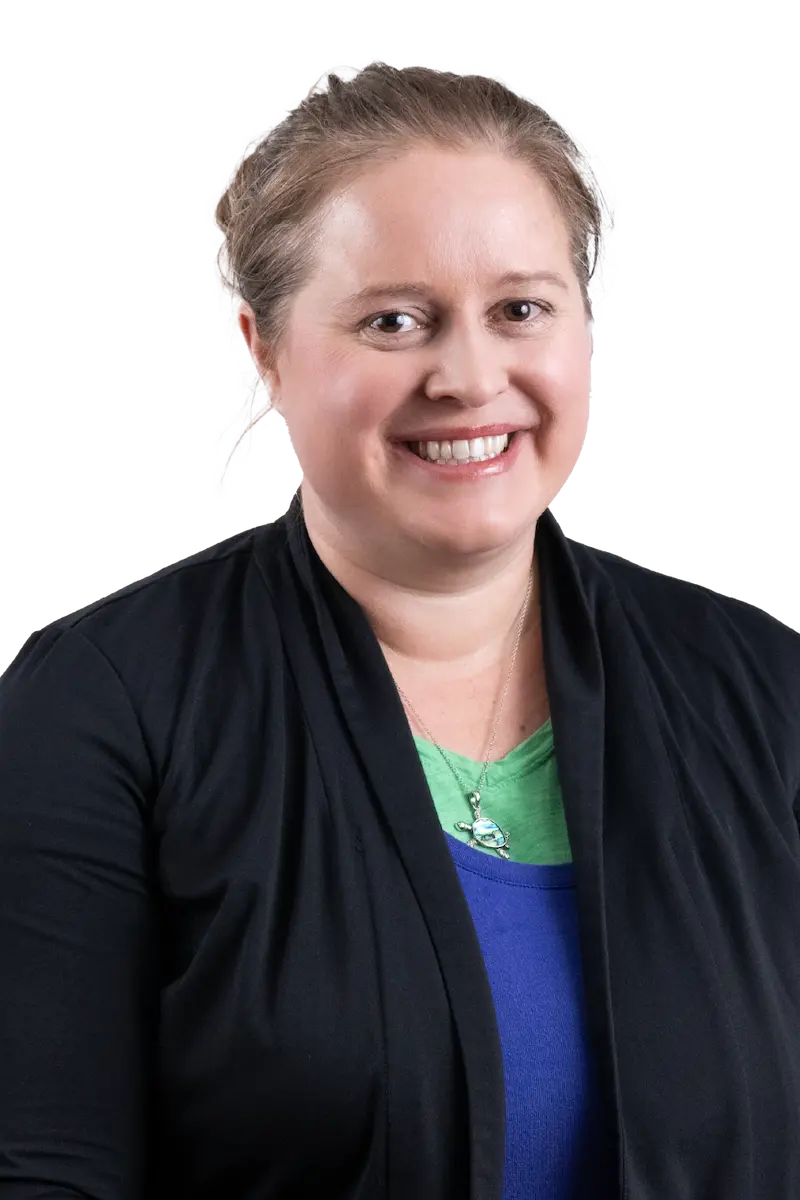
Dr. Brooke Fukuoka Interview
November 11, 2025
About Dr. Fukuoka: Driven by her commitment to improving oral health for patients with special healthcare needs and geriatric populations, Dr. Brooke is a passionate speaker and advocate for expanding access to care through innovative models like portable dentistry, teledentistry, and professionally aided home hygiene programs. She practices part-time at Your Special Smiles PLLC, serving geriatric patients in long-term care, and leads the Advanced Delivery Dental Clinic at Family Health Services of Idaho, a Federally Qualified Health Center. Active in organized and minimally invasive dentistry, Dr. Brooke recently joined Delta Dental of Washington to share her journey and expertise in delivering patient-centered, minimally invasive care to underserved communities.
In college, I worked as a teaching assistant in the anatomy and physiology cadaver lab. At that point, I wasn’t sure exactly what direction I wanted to take—I had just switched from studying photography and video production to the sciences. It quickly became clear that I was much stronger in the sciences than in the arts. One day, the lead instructor for the course suggested that I shadow a few dentists, saying he thought I might be well-suited for the profession. I took his advice, shadowed several dentists, and realized this could be a great career path for me. I applied to dental school, and after paying the tremendous tuition for my first year, I remember hoping I had made the right choice. Fortunately, I discovered that I truly enjoy dentistry.
During dental school, starting in my sophomore year, I had the opportunity to participate in several Remote Area Medical Clinics—portable, free pop-up clinics that serve people with limited access to care. These experiences gave me invaluable hands-on training as a student and, just as importantly, introduced me to incredible mentors who shaped my professional path. At these clinics, I witnessed firsthand the challenges faced by some of the most underserved populations. I also discovered the profound impact of providing care to someone who truly needed it—an experience that deeply influenced my commitment to treating underserved populations.
I like to think of minimally invasive dentistry as showing extreme respect for natural tooth structure. It’s a philosophy where preserving tooth structure becomes a guiding principle in treatment decisions. This doesn’t mean we never remove tooth structure—it means we aim to remove only what is necessary to achieve the desired result.
Silver Diamine Fluoride (SDF) has truly revolutionized the way I practice dentistry. Before SDF, especially in the world of special care and geriatric dentistry, there were many situations where I felt powerless—where it seemed like there was nothing I could do to help. This remarkable liquid has changed that. It allows me to intervene, preserve teeth, and provide comfort in ways that weren’t possible before. So what is SDF? In my book, it’s nothing short of a godsend.
I use Povi-one iodine and Fluoride Varnish. I use Papacarie in the caries removal process, I would like to use Curodont (p11-4 peptide )more, however, with the cost and the lack of Medicaid coverage for this procedure, I don't get as many opportunities as I would like to. I also practice partial caries removal and utilize a lot of glass ionomer.
Silver Diamine Fluoride doesn’t just transform care for patients—it also empowers providers. Even if a dentist isn’t comfortable placing a restoration for a patient with special healthcare needs, they can still use SDF to stop the decay. This gives patients relief and protection while they wait for a provider who can deliver comprehensive care. In this way, SDF broadens access and creates meaningful options where before there were very few.
Silver Diamine Fluoride is one of the most useful tools I see for the future of dentistry, especially in geriatric populations. It may be the key to preserving oral health in long-term care facilities, where access to traditional restorative treatment is limited. SDF also has tremendous potential in pediatric and special care dentistry. With hospital block time hard to obtain and wait times for hospital cases stretching over a year in many places, SDF allows us to stabilize disease while we wait for comprehensive care options.
