

Losing a tooth is paying off this year with the Tooth Fairy paying out a little more for kids in Washington state and throughout the western region (which also includes Alaska, Arizona, California, Colorado, Hawaii, Idaho, Montana, Nevada, New Mexico, Utah and Wyoming).
New findings from the Delta Dental 2026 Original Tooth Fairy Poll® revealed the average value of a single lost tooth during the past year in the western region saw a modest increase - up 5% from an average of $5.69 to $5.99 – following last year’s drop from a 2024 high of $8.54 per tooth.
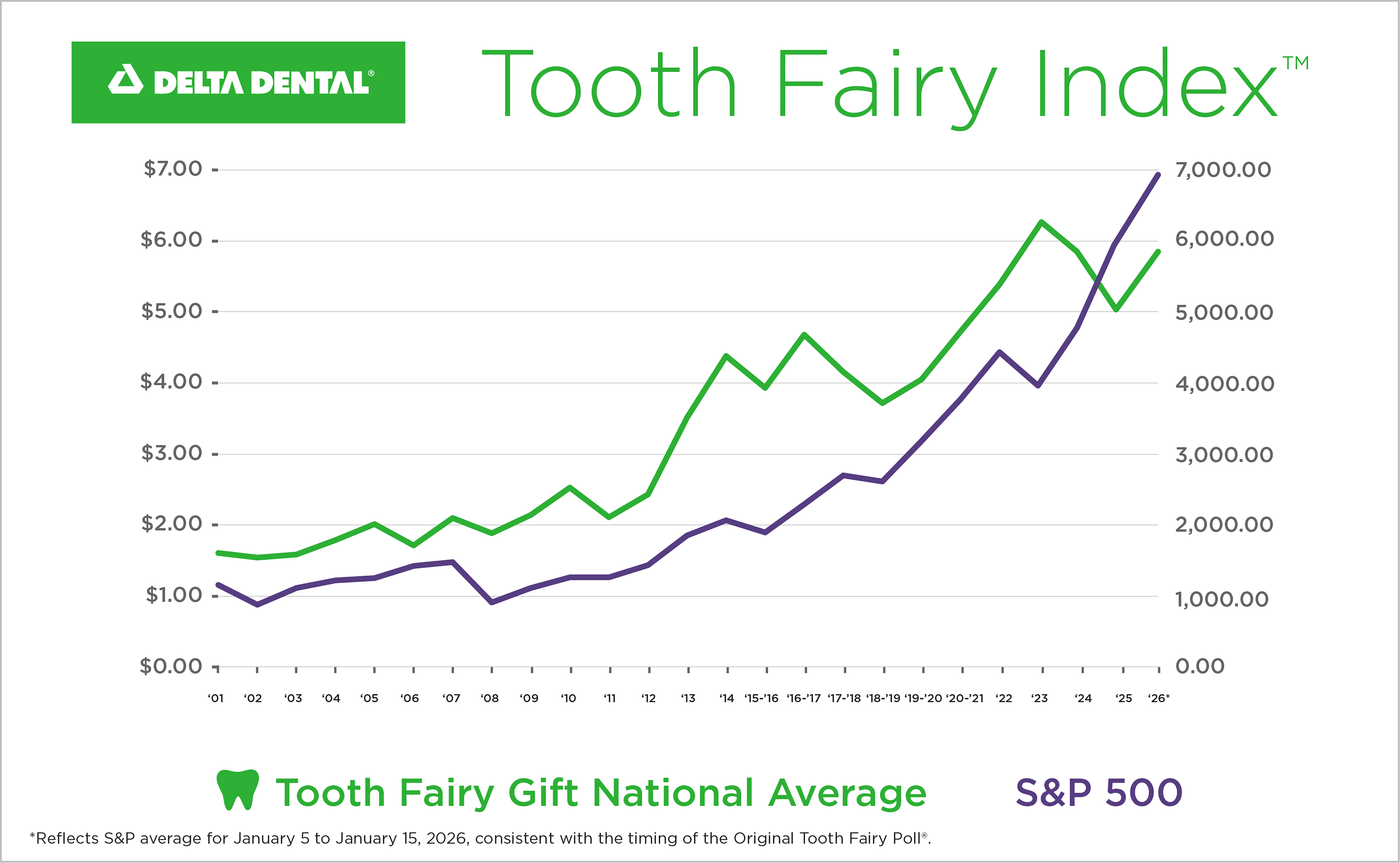
Nationally the increase was up 17% from $5.01 to $5.84. This marks the first year-over-year increase in Tooth Fairy giving since 2023, ending a two-year decline.
U.S. regional ranking for the average value of a lost tooth
- Northeast ($6.45): Led the pack with a 41% year-over-year jump.
- West ($5.99): Held steady in second place with a 5% increase from last year.
- South ($5.89): Dropped from the top spot in 2025, despite a 3% increase in giving.
- Midwest ($5.27): Made a big leap with a 52% year-over-year gain, narrowing the gap with the rest of the country
“I’m so happy to see the children throughout Washington state brushing and flossing so well, and wanted to celebrate with a well-deserved raise,” said the Tooth Fairy. “It’s so important for a bright and healthy smile to brush teeth for two minutes twice a day, floss once a day, and visit the dentist twice a year.
 The annual poll results are being released during National Children’s Dental Health Month – and just days prior to National Tooth Fairy Day (Feb. 28) – which is being celebrated with Tooth Fairy visits to several schools across the state including schools in Auburn, Bremerton, Forks, Kalama, Kennewick, Kenmore, Kent, Marysville, Monroe, Olympia, Snohomish, Spokane, Vancouver, Walla Walla and Winlock as part of Delta Dental of Washington’s free statewide K-2 dental health education program, The Tooth Fairy Experience.
The loss of a first tooth is also being rewarded more generously, worth 23% more nationally than the average lost tooth. On average, a first tooth is now valued at $7.17, up from $6.24 in 2025. More than one in three parents (38%) say the Tooth Fairy leaves extra for their child’s first tooth compared with future teeth.
"The tooth fairy's rates may have changed, but the economics of good oral hygiene remain the same: brushing twice a day with a fluoride toothpaste is an excellent return on investment," says Megan E. Miller, DDS, a Delta Dental of Washington member dentist. "Five-year-olds aren't losing sleep over future cavities — they need an incentive that makes sense right now. Parents are already fighting the good fight twice a day to make two minutes of brushing happen, so if the tooth fairy wants to fly in with some cash to sweeten the deal, that's a win for everyone."
In addition, more kids are waking up to gifts beyond cash, as non-monetary presents from the Tooth Fairy are on the rise. Nearly one in three children (32%) received a physical gift this year, up from 19% in 2025. The Tooth Fairy Experience’s blog has a list of money alternatives for parents looking to increase excitement without increasing their budget.
Delta Dental has tracked Tooth Fairy giving trends over the last 28 years to help teach kids about caring for their oral health. Since the annual poll’s inception in 1998, the average cash gift left by the Tooth Fairy nationally has surged 349% from $1.30 to $5.84 per tooth. In Washington state and across the western region, the value of a lost tooth has varied from a low of $3.97 (2020) to a high of $8.54 (2024):
- 2020: $3.97
- 2021: $5.54
- 2022: $4.08
- 2023: $6.25
- 2024: $8.54
- 2025: $5.69
- 2026: $5.99
The value of a lost tooth and the economy
Historically, the Original Tooth Fairy Poll® has typically mirrored the economy's overall direction, tracking with the trends of Standard & Poor's 500 Index (S&P 500). In recent years, however, the value of a lost tooth diverged from this pattern. For the first time since 2022, the poll has realigned with market trends. Over the past year, the average value of a single lost tooth increased 17%, in line with a similar 16% increase in the S&P 500 during the same period.
For more information from Delta Dental of Washington, visit its Guide to Children’s Oral Health and learn about The Tooth Fairy Experience, The Tooth Fairy Experience. For more information about the Delta Dental-sponsored survey, visit the Original Tooth Fairy Poll®.
About the poll
The Original Tooth Fairy Poll® was conducted between Jan. 5, 2026, and Jan. 15, 2026, among 1,000 parents of children ages 6 to 12. The margin of error is +/- 3%. The January 2025 S&P 500 average was 5,960 and increased to an average of 6,941 for January 2026, consistent with the timing of the Original Tooth Fairy Poll®.
About Delta Dental of Washington
Founded 70 years ago by Seattle area dentists who set out to revolutionize oral health care, an innovative program was developed to provide longshoremen’s children access to dental care – and the concept of dental benefits was born. Today Delta Dental of Washington, a not-for-profit, is the state’s leading dental benefits provider covering more than 4 million people statewide and beyond.
Through corporate philanthropy, oral health advocacy, and funding the Arcora Foundation, Delta Dental plays a vital role in making dental care more equitable and accessible, increasing dental health education with an emphasis on youth, and expanding diversity at all levels within the dental profession. These collective efforts aim to improve oral health care in Washington so all people can enjoy good oral and overall health with no one left behind. Delta Dental of Washington is part of the Delta Dental Plans Association, consisting of 39 independent, affiliated member companies. For more information, visit: www.deltadentalwa.com.
